
Never have I ever
loved a TV show and been super mad at it at the same time

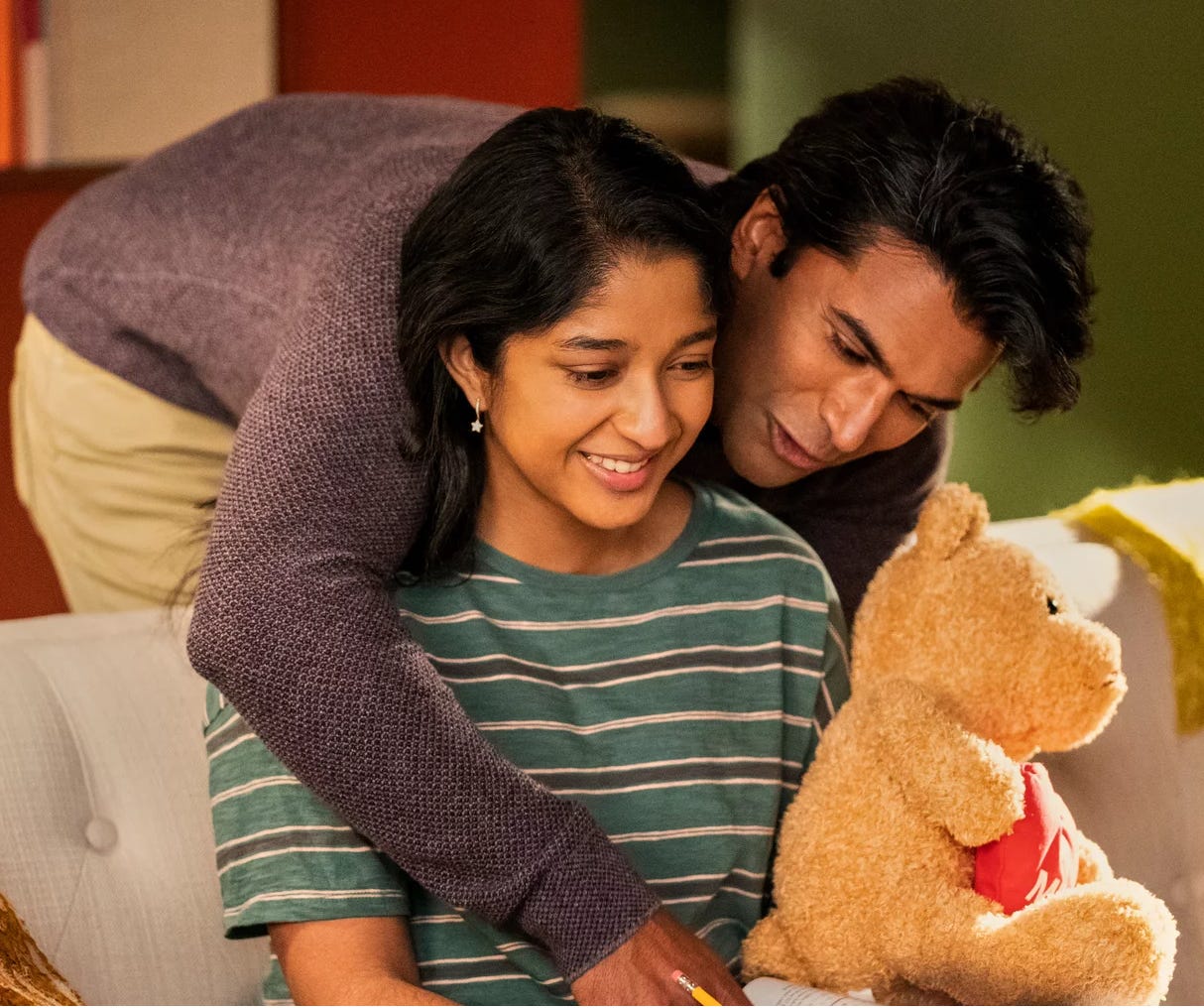
Guess what? The Curmudgeon’s Guide to College Admissions turned two last month, which means that this Substack is now a toddler and, much like a toddler, it (and I) have strong opinions. I hate naps (I wake up disoriented and frothing with rage), I love little snacks, and I really, really dislike the concept of a “dream school.”
The physical embodiment, that is. The concept of a dream school is alive and well in the hearts and minds of hundreds of thousands of teenagers and their parents. I can talk until I’m blue in the face about how harmful longing for a dream school can be, especially if the dream school happens to be highly rejective, but the fact is, I can’t kill someone’s dream. Only life and experience can do that.
So instead of stomping on people’s dreams, I want to look at how the idea of a dream school germinates and takes root. How much of it is inflected by how each of us was raised, by the expectations that were placed on us and that we, in turn, place on ourselves. And nowhere better is this dynamic reflected than in Mindy Kaling’s brilliant series Never Have I Ever—to which end I’m bringing back a post from 2024, originally titled “Let us speak ill of the dead, or why I’m mad at Devi Vishwakumar’s dad.”
It is a truth universally acknowledged that medical professionals shouldn’t watch Grey’s Anatomy and lawyers shouldn’t watch Suits and therapists shouldn’t watch Shrinking because no one wants to be in a room with a person screaming THAT WOULD NEVER HAPPEN at the screen. Which is why I, a college admissions counselor, should probably not have gotten as invested as I did in Never Have I Ever, a Netflix series about Devi Vishwakumar, a high school student who wants more than anything to get into Princeton.
Of course, the show is about more than that. It’s about grief and rage and yearning and the weirdness of being a teenager. Devi’s father collapses and dies at her ninth-grade orchestra concert in the opening episode, and for the next four seasons, Devi struggles with the aftermath, tries to lose her virginity, feuds with arch-rival Ben Gross, and butts heads with her mother. (Let’s pause here briefly to gush over admire her mother, the iconic Dr. Nalini Vishwakumar. After the sudden loss of her husband, Nalini is tasked with raising an angry, grieving teen, keeping an eye on her drop-dead gorgeous niece Kamala, who is getting a PhD at Caltech and the attention of every red-blooded male in greater Southern California, and caring for her (also) widowed mother-in-law, all while running a busy dermatology practice. The woman is legend. Did I mention she is always impeccably turned out? Did I mention that I covet, desperately, her ability to combine murder eyes with withering politeness?
But I also spent a great deal of time screaming THIS WOULD NEVER HAPPEN at the screen, and here’s why:
There is no world in which a Princeton admission officer would give out her cell to an applicant and answer calls and texts (yes, more than one, because Devi is nothing if not persistent).
Or, for that matter, offer pointed advice about how a waitlisted applicant might be able to get off a waitlist by writing another, more personal essay.
Devi’s other, more personal essay. (I was about to write, “Don’t get me started,” but I guess I’m already well on my way, so buckle up.)
The other, more personal essay
In an early episode called “(Never Have I Ever) …felt Super Indian,” Devi meets with Ron Hansen-Battarchaya, a sought-after college counselor who is famous because 90 percent of his students get into Ivies. Ron tells Devi dismissively that she’s just another hardworking Indian kid with good grades and high scores (which is mean but true—ask any admissions officer wading through a sea of applicants the vast majority of whom have good grades and high scores). But then he remembers: she’s the hardworking Indian kid with a tragically dead dad, and he’s like, “Aha! Write about losing your dad and you’re golden,” and Devi, who hasn’t even come close to making sense of the magnitude of her loss, fires back, “I don’t need some washed-up white dude who leases a Tesla telling me what makes me special.”

So Devi submits an essay to Princeton that, as Admissions Officer Akshara tells her in a phone call (WOW, SERIOUSLY? NEVER HAVE I EVER HEARD OF SUCH A THING, BUT WHATEVER), is very well-written. Very academic. Remarkable for its frequent use of the word “dichotomy.” In other words, it’s an unremarkable, try-hard essay in which Devi fails to show who she really is (Akshara’s words).
I’ve worked as a college counselor for 18 years, and I’m here to tell you that nothing strikes more terror in the heart of a young person than being asked to show who they really are, especially with so much at stake. I mean, who wants to be vulnerable and exposed? In a college essay, of all places? Like, is Devi supposed to share that she misses her dad and envies/loves her drop-dead gorgeous cousin and spent the first half of high school lusting after Paxton Hall-Yoshida (whose collegiate swim career she derailed, btw) and recently had a cringy hook-up with her arch-rival, and doesn’t know whether she’s Indian or American or what, and has only recently begun to understand how hard and lonely it’s been not just for her, but also for her mom? Of course we know all that because we’ve been watching the show. But how is Devi supposed to tell that story and convince Akshara (who, it would appear, single-handedly runs Princeton’s admission office) to let her in?
Encouraged by Ben, former arch-rival and now her biggest champion, Devi writes a “better” essay. We know it’s better, because it works! Devi is admitted to Princeton off the waitlist! Confetti emoji! We viewers are satisfied, because what is this if not the perfect culmination of the hero’s journey? Devi’s quest for a Princeton acceptance is successful only after she has been humbled, visited the underworld (which, at Sherman Oaks High, means the dark place you go to after being rejected or waitlisted at ALL the Ivies after foolishly (hubristically!) applying only to the Ivies), and emerged appropriately chastened.
Except that the new, “better” essay is not about Devi at all. It’s a tribute to her dad. It’s a series of softly-lit flashbacks to Mohan Vishwakumar being great, and it makes the argument that Devi should be admitted because Princeton would be admitting her and, in effect, her dad.
Don’t get me wrong. Devi’s dad is great. He’s kind, he’s funny, he’s playful, he’s eternally optimistic, he perfectly complements the more guarded, more skeptical Nalini. He leaves a gaping hole after his untimely death. He’s the dad we wish we had, as opposed to a real-life dad, perfectly juxtaposed here:
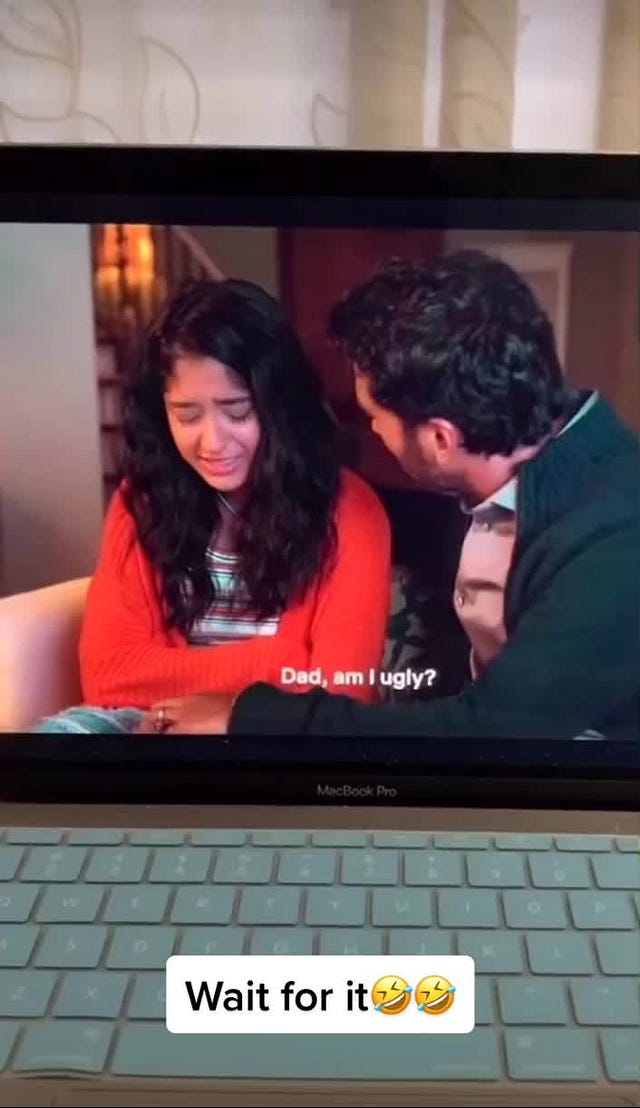
 Tiktok failed to load.
Enable 3rd party cookies or use another browser
Which brings me to the part that I’m most mad about,
not because it would never happen, but because it happens ALL. THE. TIME. I’ve seen it in my practice over and over, and it’s called Foisting Parent Dreams on Children Not Old Enough to Know Better. I’m talking about a scene that comes right after Devi’s therapist, played by the incomparable Niecy Nash, asks Devi to consider that maybe her Princeton dream, with such power over her self-worth, might not be serving her, and Devi flashes back to the first day of first grade.
In the flashback, little Devi and her dad are having breakfast, and the dad starts a totally normal and not at all troubling conversation that any parent might start with a seven-year-old:
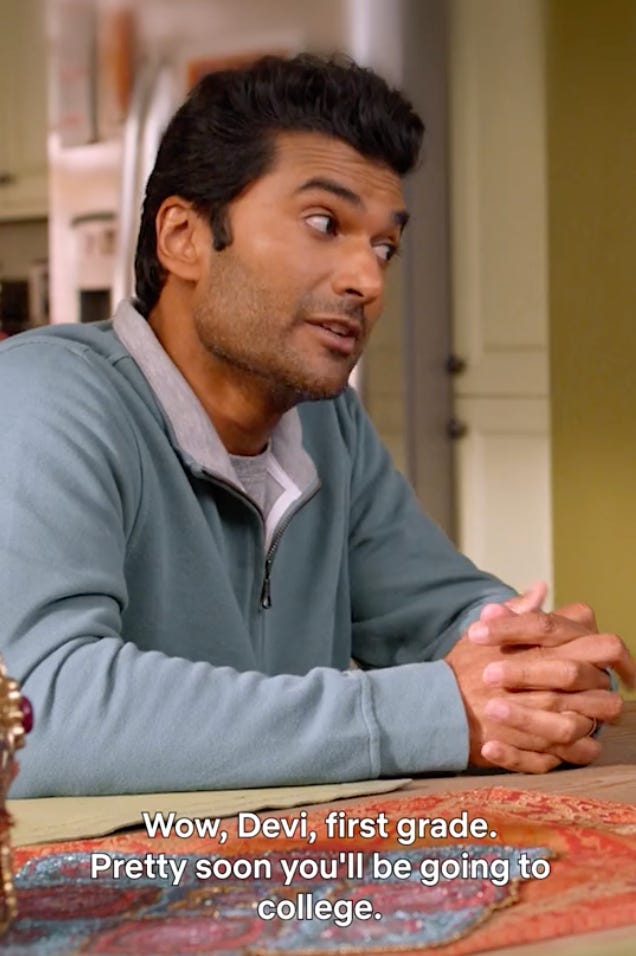
The first-grade-to-college pipeline! Because you need to start preparing early, as all parents seeking college advice for children who don’t yet have all their adult teeth know.
And then the next question:
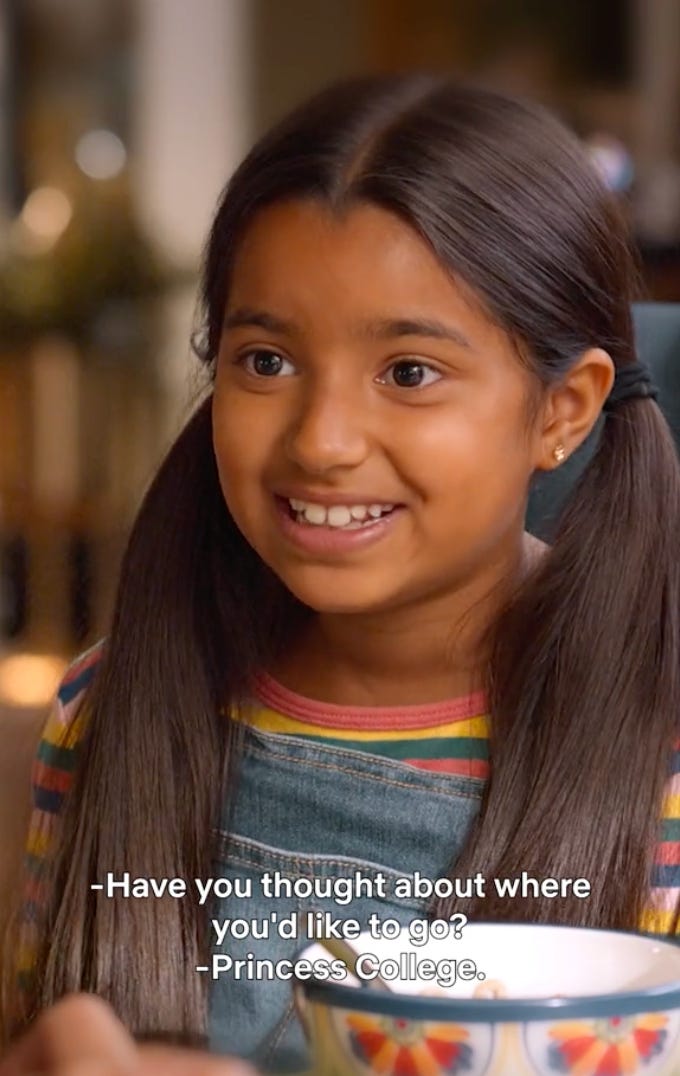
WTF, Devi’s dad? Why would you ask your seven-year-old kid where she’d like to go to college? Where do you think she’d like to go? To Baskin-Robbins, to the park, to Chuck E. Cheese (ew, but please note that Chuck E. Cheese is a place WHERE A KID CAN BE A KID). Of course sweet Devi wants to go to Princess College (which, btw, should totally be a thing).
But no, says Mohan. There’s no such thing as Princess College. There is, however…
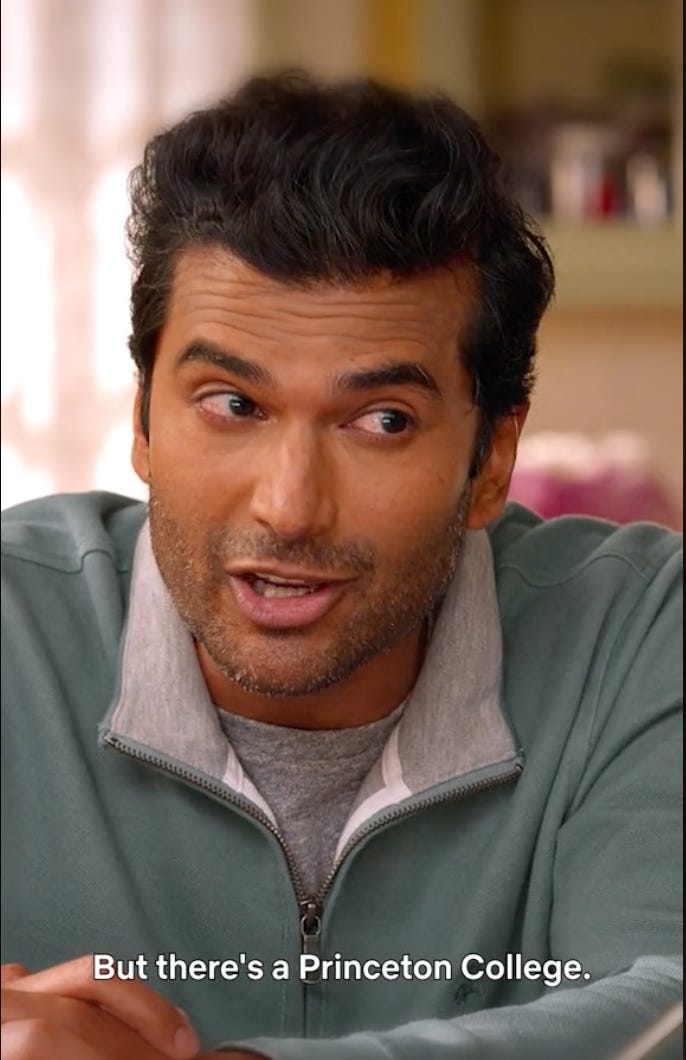
…a Princeton College. (Ahem, university.) Good to get clear on that when they’re young!
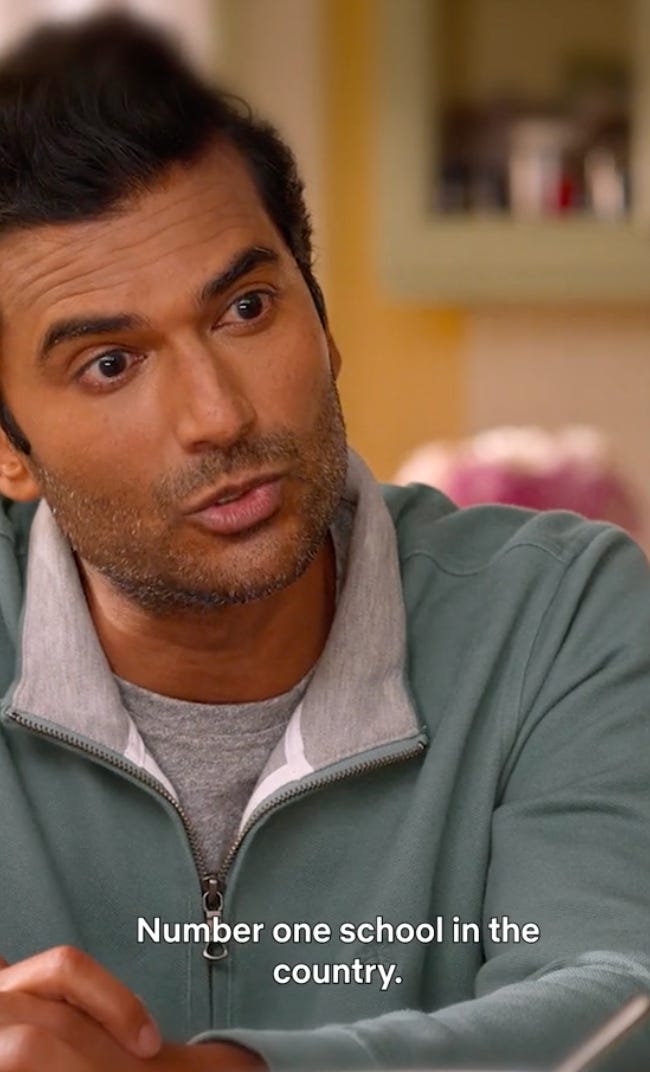
‘Nuff said. I mean, why would you even want to go to a number two school?
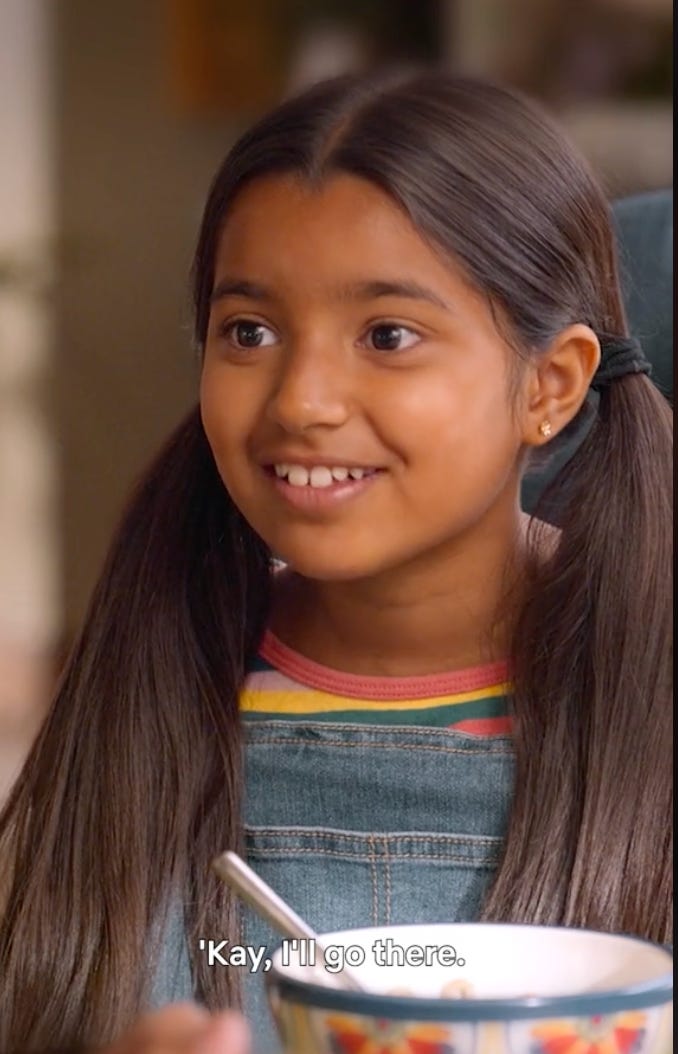
And why would Devi say anything other than “ ‘Kay, I’ll go there” to the man she loves more than anything else in the world?
Watch what happens next: the shift where just like that, Princeton becomes Devi’s idea:
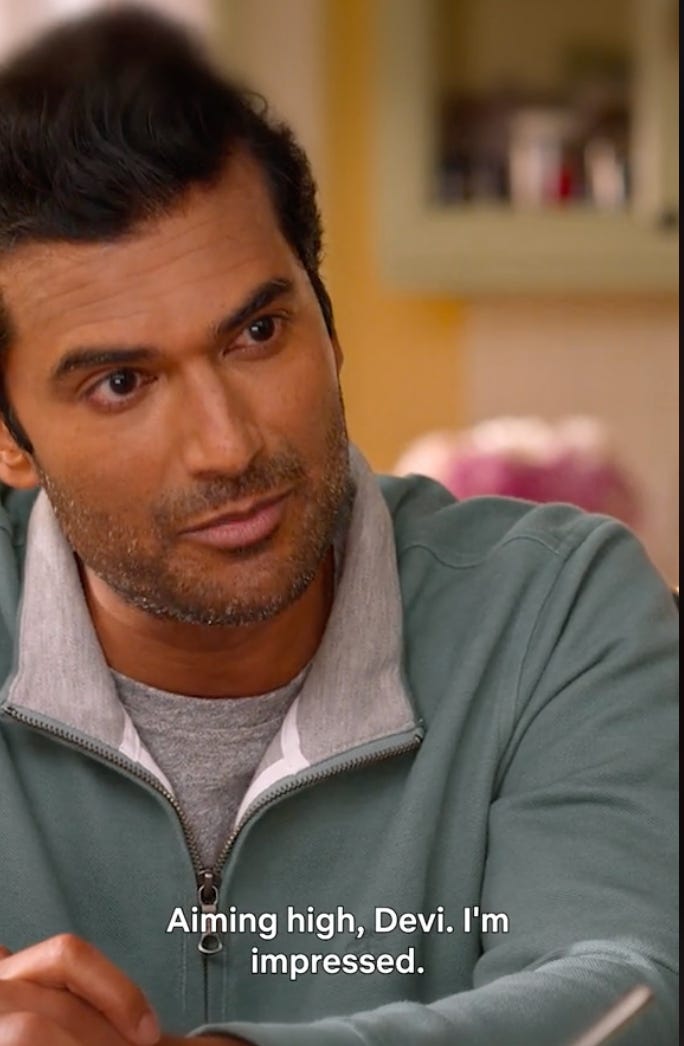
DEVI IS NOT AIMING HIGH, MOHAN! DEVI IS TRYING TO PLEASE YOU BECAUSE SHE IS A SEVEN-YEAR-OLD WHO LOVES YOU AND THINKS YOU’RE THE MOST KNOWLEDGEABLE, MOST AMAZING HUMAN BEING THAT EVER LIVED!
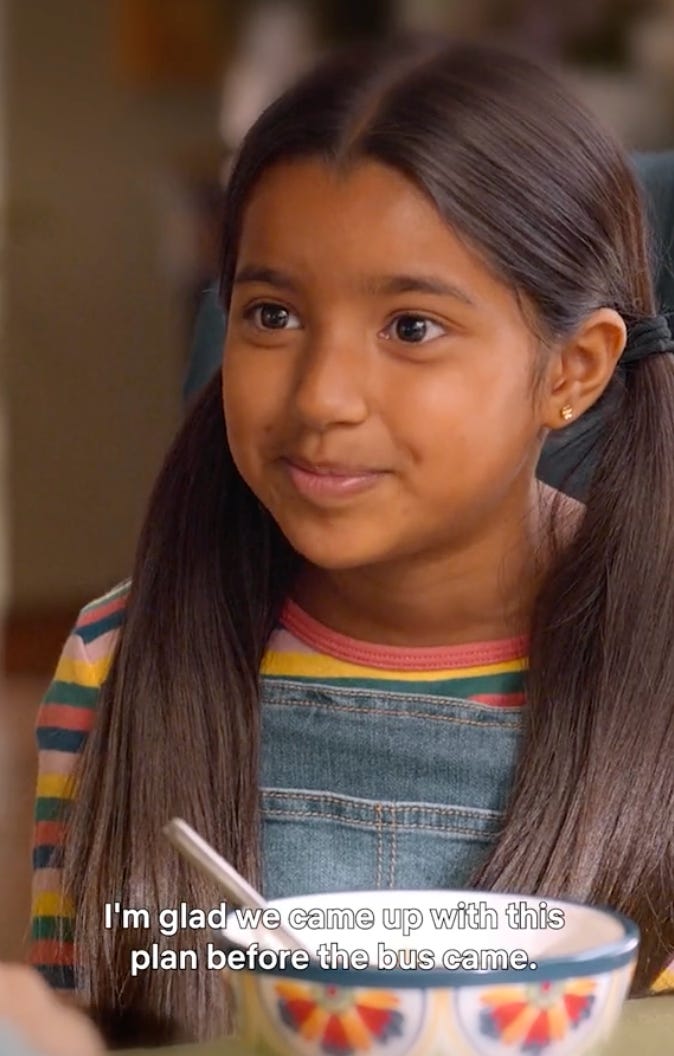
aaaand it’s all settled. “I’m glad we came up with this plan before the bus came,” says Mohan, and then he goes and dies and now Devi is left holding the Princeton dream because it’s a way to hold on to her dad.
And here’s the twist: Devi’s realization that Mohan will be a part of her forever, Princeton or not, is ultimately what gets her in. (We all know this is true: you have to renounce the dream to have the dream.) Princeton is the happy ending. But I still want to know: what is Princess College? Why isn’t there one? What if little Devi were given permission to chase that dream? And will grown-up Devi foist her dreams on her children, or will she let them find their own?
Updates:
•Mark your calendars for our next Curmudgeon Chat on Sunday, May 24 at 9 am Pacific! Our topic will be “How (and Whether) to Pick a Major.” Paid subscribers will receive a Zoom link the day before the meeting. I hope to see many of you there!
•Want to read more about what we absorb from our parents and pass on to our children? Check out my new book, Troika: Three Generations, Three Days, and a Very American Road Trip, available everywhere books are sold. It’s about three generations of women—my mother, my adult daughter, and me—on a short road trip to California’s Central Coast, and also about Greek myth, migration, memory, motherhood, aggressive ostriches, California history, and the second season of The White Lotus.
•And speaking of motherhood: come see me tell a story at a virtual story slam this coming Sunday, May 16. The theme is Mothers and Daughters; the host is the inimitable Nan Tepper; and the ticket info is here.
I want to sit around in pajamas with you mystery-science-theater-3000-ing the shit out of shows and movies.
When I finish cackling hysterically I am adding this to my watch list.
At the very least I need to see how the show portrays the niece who's getting a PhD at Caltech because I am expecting it will be almost as inaccurate as the admissions office aspects.